
FPSO Piping Materials: Why Composite Pipes Are Used Offshore
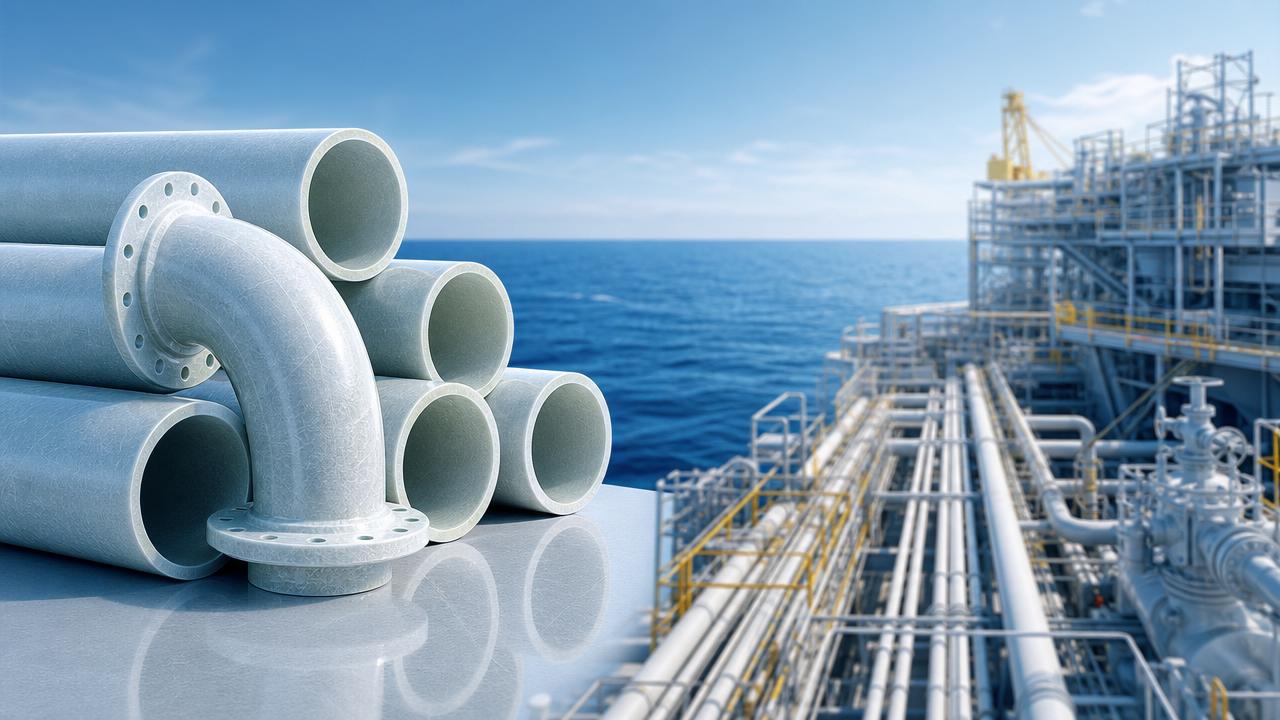
Choosing the right piping materials for an FPSO is critical to offshore safety, corrosion control, weight reduction, and long-term operating efficiency.
As floating production units face seawater exposure, chemical media, pressure fluctuations, and limited maintenance access, traditional metallic piping can present challenges in durability and lifecycle cost.
This article explores why composite pipes, especially fiberglass reinforced epoxy systems, are increasingly used offshore and how they support reliable performance in demanding oil and gas applications.
Why FPSO piping material decisions are different offshore
An FPSO is not only a production asset; it is also a marine structure, storage facility, and process plant operating in one compact space.
That combination creates unusual piping requirements. A material must resist corrosion, manage fluid compatibility, reduce topside weight, and remain maintainable during long service intervals.
- Seawater systems expose piping to chloride-rich media, oxygen, biofouling risk, and continuous wet-dry marine conditions.
- Produced water, chemicals, and utility services may require different resin systems, pressure ratings, and jointing methods.
- Space limitations make maintenance access difficult, so material selection should reduce inspection burden and unplanned replacement.
- Weight control matters because every saved kilogram can influence deck load, installation handling, and project economics.
For information researchers comparing FPSO piping options, the question is rarely “metal or composite” in isolation. It is a system-level decision.
What composite pipes mean in FPSO applications
Composite pipe is a broad category, but offshore projects often focus on fiberglass reinforced epoxy, commonly known as GRE, for marine and utility services.
GRE pipe combines glass fiber reinforcement with an epoxy resin matrix. The glass fibers provide mechanical strength, while the resin contributes corrosion resistance and chemical compatibility.
Why GRE is relevant to glass and ceramic material industries
The glass fiber component is central to performance. Fiber orientation, winding control, resin wet-out, curing, and fitting fabrication affect pressure resistance and dimensional stability.
In an FPSO project, these material characteristics connect directly with installation reliability, hydrostatic testing outcomes, and long-term resistance to offshore degradation.
GRE is commonly evaluated for seawater cooling, ballast water, fire water, drain lines, and selected chemical services where design conditions permit.
Composite pipe versus metallic pipe: where the trade-offs appear
Researchers evaluating FPSO piping materials usually compare corrosion behavior, weight, installation complexity, and long-term maintenance exposure before narrowing a technical shortlist.
The decision is not universal. Metallic pipe remains necessary for many high-temperature, high-pressure, or mechanically exposed FPSO duties.
However, for suitable non-metallic service lines, GRE can lower corrosion risk and simplify long-term maintenance planning.
Which FPSO systems are strong candidates for GRE piping?
Composite materials are most convincing when the service environment aligns with their strengths. On an FPSO, seawater-related systems often lead the discussion.
For marine ballast requirements, many buyers also study The application of GRE piping in marine ballast water systems to understand practical offshore value.
A good FPSO selection process starts with service classification, not product preference. Media, temperature, pressure, and access determine suitability.
If the route includes mechanical collision zones or extreme thermal exposure, protective design and alternative materials should be reviewed early.
Technical factors buyers should verify before specifying FPSO composite pipe
A datasheet alone cannot confirm offshore suitability. FPSO buyers should connect each technical parameter to a real operating condition.
Pressure, temperature, and fluid compatibility
Design pressure should include operating pressure, surge conditions, test pressure, and project safety factors. Temperature must reflect continuous and occasional exposure.
For chemical service, the resin system should be checked against concentration, exposure time, cleaning chemicals, and possible mixed-media conditions.
Jointing, supports, and hydrostatic testing
- Confirm whether bonded joints, flanged connections, or mechanical couplings are preferred for the FPSO installation sequence.
- Review pipe supports, saddle contact surfaces, expansion allowances, and vibration exposure near pumps or rotating equipment.
- Plan hydrostatic testing procedures before shipment or installation, especially for prefabricated spools and complex fittings.
- Check handling instructions because composite pipe can be strong in service but sensitive to improper lifting or impact damage.
These details are practical, not academic. They influence commissioning speed, rework risk, and confidence during FPSO acceptance inspections.
Procurement checklist for FPSO piping research teams
Information researchers often need to compare suppliers before technical drawings are final. A structured checklist helps avoid vague quotations.
A supplier should be evaluated on engineering communication as well as product pricing. Offshore delays can cost more than material differences.
Cost logic: why lifecycle cost matters more than unit price
For FPSO piping, the cheapest unit price may not produce the lowest project cost. Installation, coating, maintenance, downtime, and replacement risk matter.
Where composite pipe can influence total cost
- Lower pipe weight can reduce handling effort, support loads, and some installation constraints during module fabrication.
- Corrosion resistance can reduce dependence on internal linings, external coating repairs, and repeated corrosion inspections.
- Prefabricated fittings and pressure-tested components may help projects control schedule risk before offshore integration.
- Wrong material selection can create rework, so early technical confirmation is essential before final procurement.
A practical FPSO cost review should compare lifecycle assumptions over the intended service period, not only initial purchase cost.
Standards, compliance, and documentation considerations
Offshore piping projects commonly refer to recognized rules, client specifications, classification requirements, and project-specific acceptance documents.
For GRE systems, buyers may review general practices related to composite pipe design, pressure testing, fire performance expectations, and installation qualification.
Documentation to request during early research
- Material specification sheets showing resin type, reinforcement approach, pressure class, temperature range, and service limitations.
- Hydrostatic test records or testing plans aligned with the project’s FPSO acceptance procedure.
- Installation guidance covering joint preparation, curing conditions, support spacing, flange connections, and repair rules.
- Packing and logistics details that protect pipe ends, fittings, and surfaces during international transport.
Clear documentation helps bridge the gap between engineering design, purchasing approval, shipyard installation, and final FPSO commissioning.
Common mistakes when researching FPSO composite piping
Many material problems start before procurement. The issue is often incomplete operating data rather than poor product quality.
Mistake 1: Treating every seawater line the same
A ballast line, cooling line, and fire water line may all contact seawater, but their pressure, emergency function, and routing differ.
Mistake 2: Ignoring field installation conditions
Bonded composite joints need controlled procedures. Humidity, surface preparation, curing time, and installer training can affect FPSO schedule reliability.
Mistake 3: Comparing quotations without fittings and tests
Pipe length pricing alone is incomplete. Fittings, flanges, spools, testing, packing, and documentation can significantly change the final package value.
FAQ: practical questions about FPSO GRE piping
The following questions reflect common search intent from engineers, purchasers, and project researchers comparing FPSO piping material options.
Is GRE pipe suitable for every FPSO line?
No. GRE is suitable for selected services after checking pressure, temperature, fluid chemistry, fire requirements, and mechanical exposure. It is not a universal replacement.
What should be confirmed before requesting an FPSO quotation?
Share line size, pressure class, fluid, temperature, route conditions, fittings list, testing requirements, delivery destination, and any project documentation expectations.
Why is weight reduction important on an FPSO?
Lower weight can support module design, lifting plans, deck load management, and installation efficiency, especially where large-diameter seawater systems are involved.
How does supplier capacity affect offshore projects?
Capacity affects production scheduling, fitting availability, testing coordination, and shipment planning. For FPSO projects, delayed components can disrupt broader fabrication sequences.
Why choose Shandong Ocean Pipe for FPSO piping research and supply
Shandong Ocean Pipe Technology Co., Ltd. was established in 2012 in Wucheng Industrial Park, Dezhou City, Shandong Province, China.
With a registered capital of USD 4,200,000, Ocean Pipe has developed into one of China’s major manufacturers of fiberglass reinforced epoxy pipe.
The company operates 16 winding production lines, 174 sets of pipe fitting winding machines, and winding micro control systems for pipe and fitting production.
Its factory is equipped with 5 static water pressure testing machines, supporting an annual GRE pipe production and testing capacity of 25,000 tons.
Ocean Pipe products are used in oil and gas, ship ballast piping, LNG, chemical plants, hot spring piping, and salt making applications.
The company has supplied customers including CNOOC, CNPC, Sinopec, Shanghai Waigaoqiao Shipyard, Ningbo Xinle Shipyard, and Wuhan Qingshan Shipyard.
Markets have also expanded to Australia, Iraq, Kazakhstan, Turkey, and other overseas regions, supporting international project communication and delivery coordination.
What you can discuss with our team
- FPSO service conditions, including seawater, ballast, cooling water, fire water, and selected chemical utility lines.
- Pipe diameter, pressure class, fittings, flanges, spool needs, and hydrostatic testing expectations.
- Customized GRE pipe solutions based on routing constraints, installation sequence, and documentation requirements.
- Delivery cycle, packing method, sample support, quotation scope, and technical data for internal procurement review.
If you are comparing FPSO piping materials, contact Ocean Pipe with your operating data and project schedule for a practical GRE selection discussion.
Please give us a message
产品介绍产品介绍产品介绍产品介绍产品介绍产品介绍产品介绍产品介绍产品介绍产品介绍产品介绍产品介绍产品介绍产品介绍产品介绍产品介绍产品介绍产品介绍产品介绍产品介绍产品介绍产品介绍产品介绍产品介绍产品介绍产品介绍产品介绍产品介绍产品介绍产品介绍
Please give us a message
产品介绍产品介绍产品介绍产品介绍产品介绍产品介绍产品介绍产品介绍产品介绍产品介绍产品介绍产品介绍产品介绍产品介绍产品介绍产品介绍产品介绍产品介绍产品介绍产品介绍产品介绍产品介绍产品介绍产品介绍产品介绍产品介绍产品介绍产品介绍产品介绍产品介绍
Please give us a message
产品介绍产品介绍产品介绍产品介绍产品介绍产品介绍产品介绍产品介绍产品介绍产品介绍产品介绍产品介绍产品介绍产品介绍产品介绍产品介绍产品介绍产品介绍产品介绍产品介绍产品介绍产品介绍产品介绍产品介绍产品介绍产品介绍产品介绍产品介绍产品介绍产品介绍
Please give us a message
产品介绍产品介绍产品介绍产品介绍产品介绍产品介绍产品介绍产品介绍产品介绍产品介绍产品介绍产品介绍产品介绍产品介绍产品介绍产品介绍产品介绍产品介绍产品介绍产品介绍产品介绍产品介绍产品介绍产品介绍产品介绍产品介绍产品介绍产品介绍产品介绍产品介绍