
What to compare before replacing stainless steel with GRE Tubing
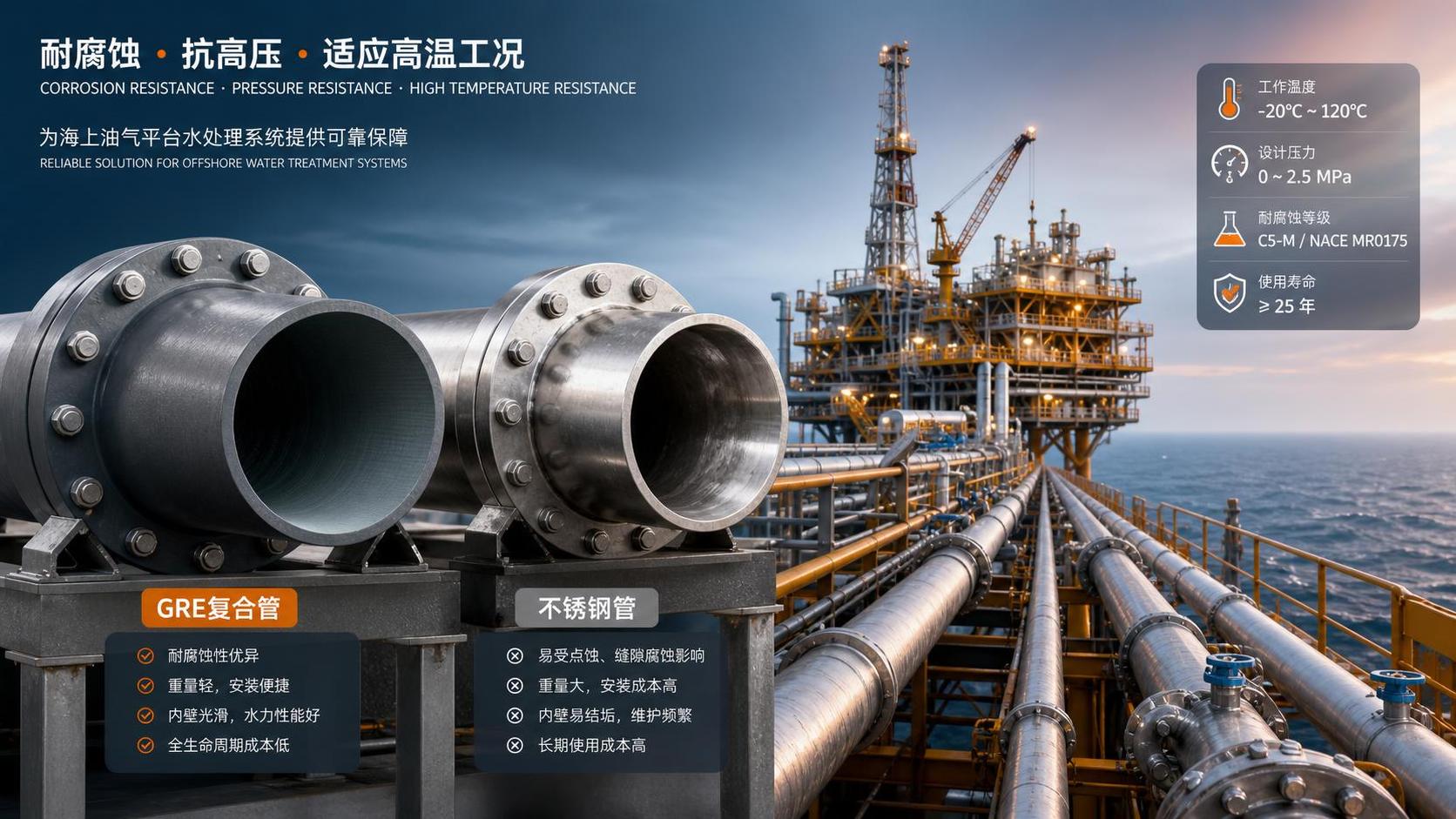
If you are evaluating whether to replace stainless steel with GRE Tubing in an oil and gas system, the first thing to check is not price. It is service fit. GRE can outperform stainless steel in the right corrosive duty, but it is not a universal substitute. The real comparison comes down to corrosion behavior, pressure and temperature envelope, joining method, support design, fire and impact exposure, inspection practice, and the actual cost of keeping the line in service over time.
A lot of evaluation teams get stuck because they compare material names instead of operating conditions. Stainless steel sounds safer because it is familiar. GRE sounds attractive because it is corrosion resistant and lighter. Neither shortcut is enough. What matters is whether the line’s fluid, temperature cycling, pressure profile, installation environment, and maintenance expectations match what GRE is designed to do.
Start with the service conditions, not the material preference
Before you compare datasheets, write down the real duty of the line. Is it produced water? Fire water? Utility water? Seawater injection support service? Chemical transfer? Open drain? A stainless steel line that has been failing from chlorides, under-deposit corrosion, or recurring maintenance creates a very different evaluation case than a clean utility line with stable temperature and no corrosion history.
In many oilfield and offshore-related applications, GRE Tubing is considered because the corrosion problem is already costing time and money. That is where GRE often makes sense. It does not rust, it is resistant to many aggressive water services, and it reduces dependence on coatings or corrosion allowance. But if the line is exposed to high temperature excursions, repeated mechanical abuse, or service conditions beyond the resin system’s limits, stainless steel may still be the better engineering choice.
A practical short answer is this: compare the process envelope first, then the failure modes, then the installation constraints. If GRE solves the actual failure mechanism without creating a new one, it deserves serious consideration.
Corrosion resistance is usually the main driver, but it needs to be specific
This is where GRE usually enters the conversation. Stainless steel does well in many services, but in oil and gas facilities it can still suffer from pitting, crevice corrosion, chloride stress corrosion cracking, or external corrosion under insulation depending on grade, environment, and maintenance quality. If those are the reasons for replacement, GRE should be evaluated against the exact fluid chemistry and upset conditions, not just normal operation.
Many teams make one of two mistakes here. The first is assuming “corrosion resistant” means resistant to everything. The second is assuming all GRE products behave the same. In reality, resin system, curing quality, liner construction, joint design, and manufacturing consistency all affect chemical resistance and service life.
Ask for compatibility data for the specific medium and concentration range. Then check whether the system will see cleaning chemicals, oxygen ingress, solids erosion, or temperature spikes during shutdown and startup. A line that handles treated water most of the time but occasionally sees aggressive chemicals is not the same as a steady utility service.
If your project is in a water-heavy environment such as seawater handling or desalination-related support systems, GRE is often reviewed alongside other non-metallic options. That is also why some evaluators look at applications such as GRE Pipe Desalination Plants when they want a reference point for corrosion-focused system design, even though final suitability still depends on the exact operating duty.
Pressure rating matters, but so does the way pressure behaves
People sometimes compare stainless steel wall thickness to GRE pressure class as if they were directly equivalent. They are not. GRE pressure performance depends on design basis, reinforcement structure, joint efficiency, temperature derating, and the long-term stress behavior of the composite.
For technical evaluation, static design pressure is only the beginning. You also need to ask:
- Are there frequent surges, pulsation, or water hammer events?
- Will the line see vacuum conditions?
- Is the pressure continuous, intermittent, or cyclic?
- Are there thermal expansion loads feeding into anchors and joints?
GRE can perform very well in properly engineered pressure service, but it is less forgiving of bad support spacing, uncontrolled surge, and installation-induced stress. Stainless steel often tolerates site abuse better. GRE requires the system design to be cleaner.
This is not a weakness so much as a design reality. If your facility has frequent pump trips, poor valve control, or a history of pressure transients, the pressure comparison should include surge analysis, not just nominal pressure class.
Temperature is where many replacement ideas fail
If there is one item that deserves extra caution, it is temperature. Not because GRE is fragile, but because many early screening decisions underestimate how many “short” temperature excursions a line actually sees in operation.
Stainless steel usually gives evaluators psychological comfort here because its temperature capability is broad. GRE systems are different. Their allowable operating range depends on the resin formulation and the manufacturer’s qualified design. Once temperature rises, pressure capability may need to be derated. The line may still work, but only within verified limits.
Do not check only normal operating temperature. Check upset temperature, steam cleaning exposure, solar heating for above-ground lines, heat tracing influence, and startup or shutdown excursions. A produced water line that normally runs cool but occasionally sees hotter slugs can invalidate a simple material substitution.
If the actual temperature profile is uncertain, that uncertainty itself is a decision factor. In those cases, the right answer is often “measure first, choose second.”
Mechanical behavior: lighter does not mean simpler
GRE Tubing is lighter than stainless steel, and that can reduce handling effort, support steel demand, and installation time. On paper, this looks like an easy advantage. In practice, lighter weight changes the mechanical design logic.
GRE has different stiffness, different expansion behavior, and different response to point loads and impact. Support spacing, clamp details, guide locations, and nozzle load assumptions all need review. If the original stainless system had field improvisation, misalignment, or uneven support conditions, GRE may expose those problems quickly.
This is why a direct “same route, same supports, just change material” approach is risky. The line may fit, but the stress picture may not. Areas near pumps, skids, vibrating equipment, and deck penetrations deserve special attention.
For buried or harsh external environments, also compare abrasion risk, settlement, ultraviolet exposure where relevant, and accidental impact from maintenance activities. GRE often performs well when the full installation method is engineered properly. It performs poorly when teams treat it like metal pipe with a different name.
Installation and joints often decide whether the project succeeds
This point is easy to underestimate in office reviews. Stainless steel fabrication relies on familiar cutting, welding, and fit-up practices. GRE installation relies more heavily on controlled joint preparation, adhesive or laminated joint quality where applicable, cure management, alignment discipline, and trained crews.
So the question is not only whether GRE is suitable. It is whether your project environment is suitable for GRE installation quality.
If you are working in a remote brownfield site with limited environmental control, rushed shutdown windows, and mixed contractor capability, joint quality becomes a major risk item. If you have a qualified installer, a clear procedure, inspection hold points, and realistic installation sequencing, that risk drops sharply.
Technical evaluators should ask suppliers very direct questions here: What joint systems are proposed? What installer qualifications are required? What field testing is expected after installation? What repair method applies if a joint is rejected? Those details matter more than brochure language.
Fire, impact, and damage tolerance need an honest look
Some services are ruled by corrosion. Others are ruled by consequence of damage. GRE is not the default answer for every line in a hydrocarbon facility because fire performance, impact resistance, and damage detectability may carry more weight than corrosion resistance in certain zones.
If the line is near high-traffic maintenance areas, crane paths, hot work zones, or equipment where fire exposure defines the design basis, your comparison needs facility-specific review. This is one reason experienced teams separate “can GRE carry this fluid?” from “should GRE be installed in this location?” Those are different questions.
In lower-risk water and utility services, this concern is often manageable. In critical areas, it may become the deciding factor.
Lifecycle cost is where GRE can win, but only with realistic assumptions
Many buyers compare only purchase cost and installation cost. That misses the main reason GRE is considered in oil and gas operations: reduced corrosion-related intervention over time.
If stainless steel in your actual service requires recurring replacement, passivation work, corrosion monitoring, insulation removal, leak repair, or shutdown-related maintenance, the cost picture changes fast. GRE may reduce those burdens significantly in the right application. But you need a fair model. Include:
- Expected service life under the actual process envelope
- Inspection method and frequency
- Repairability in the field
- Downtime consequence if failure occurs
- Installer training and quality control cost
- Spare fittings and long-term supply continuity
This is also where supplier capability matters. A composite piping system is not just a material; it is a manufacturing and quality system. Ocean Pipe, established in 2012 in Shandong, has built large-scale GRE production capacity with multiple winding lines and hydrostatic testing equipment, and its products have been supplied into oil and gas, ship ballast, LNG, chemical, and related industrial sectors. For evaluators, that kind of background is useful not as a sales point by itself, but as one indicator to check manufacturing scale, testing discipline, and project experience when comparing vendors.
Where GRE Tubing usually makes sense, and where it usually does not
GRE is often a strong candidate in corrosive water service, seawater-related systems, ballast and utility lines, and other duties where corrosion drives maintenance more than high temperature or severe mechanical abuse. It becomes more attractive when weight reduction and easier handling also have project value.
It is usually a weaker candidate when the service includes high sustained temperature, poorly controlled thermal excursions, severe impact exposure, difficult fire-performance requirements, or process conditions that are not fully characterized.
One more common mistake: people ask whether GRE is “better” than stainless steel. That is the wrong frame. The right question is whether GRE is better for this line, in this environment, under this operating discipline.
A practical evaluation sequence
If you need to move from discussion to decision, use a short screening sequence:
- Confirm actual fluid chemistry, solids content, and upset conditions.
- Verify operating temperature, excursion temperature, and pressure transient behavior.
- Review line routing, supports, vibration points, and external damage exposure.
- Check applicable standards, owner specifications, and fire-zone restrictions.
- Compare jointing method, installer capability, and inspection plan.
- Build a lifecycle cost view using maintenance history, not just purchase price.
- Ask shortlisted suppliers for service-specific technical validation, not generic brochures.
That last step matters. The stronger suppliers will speak clearly about limits as well as advantages. If a vendor avoids discussing derating, joint control, or service exclusions, treat that as useful information.
FAQ
Can GRE Tubing replace stainless steel one-for-one in an existing system?
Usually no. Even when the service is suitable, supports, expansion behavior, jointing details, and surge response often need redesign.
Is GRE always cheaper over the full project life?
Not always. It can be cheaper where corrosion drives maintenance, but the answer depends on installation quality, service conditions, and failure consequence.
What is the biggest technical risk in switching to GRE?
In many projects, it is not the pipe body. It is using GRE in a temperature or mechanical environment that was not properly checked, or underestimating field joint quality.
Should corrosion history alone justify the material change?
No. Corrosion history is a strong trigger for evaluation, but the replacement decision still has to pass pressure, temperature, mechanical, and installation review.
Final check before you decide
If your stainless steel system is failing because the service is chemically aggressive and the operating envelope sits comfortably within qualified composite limits, GRE Tubing may offer better long-term value with less corrosion-related maintenance. If the line lives in a hot, impact-prone, fire-sensitive, or poorly controlled operating environment, stainless steel may remain the more dependable option.
The right comparison is not metal versus composite in the abstract. It is failure mode versus failure mode, cost versus maintenance burden, and design discipline versus operating reality. That is the level where a material change becomes defensible.
- Anchor text: GRE pipe for seawater systems - category or application page
- Anchor text: GRE vs stainless steel piping - comparison article
- Anchor text: Composite pipe pressure and temperature limits - technical guide page
- Anchor text: GRE installation and jointing requirements - engineering support page
- Anchor text: Oil and gas water handling pipeline materials - industry solutions page
- External source direction: Owner or operator engineering standards for non-metallic piping in oil and gas facilities
- External source direction: Composite pipe manufacturer technical manuals and chemical resistance documentation
- External source direction: Industry association standards and guidance for fiberglass or reinforced thermosetting resin piping systems
Please give us a message
产品介绍产品介绍产品介绍产品介绍产品介绍产品介绍产品介绍产品介绍产品介绍产品介绍产品介绍产品介绍产品介绍产品介绍产品介绍产品介绍产品介绍产品介绍产品介绍产品介绍产品介绍产品介绍产品介绍产品介绍产品介绍产品介绍产品介绍产品介绍产品介绍产品介绍
Please give us a message
产品介绍产品介绍产品介绍产品介绍产品介绍产品介绍产品介绍产品介绍产品介绍产品介绍产品介绍产品介绍产品介绍产品介绍产品介绍产品介绍产品介绍产品介绍产品介绍产品介绍产品介绍产品介绍产品介绍产品介绍产品介绍产品介绍产品介绍产品介绍产品介绍产品介绍
Please give us a message
产品介绍产品介绍产品介绍产品介绍产品介绍产品介绍产品介绍产品介绍产品介绍产品介绍产品介绍产品介绍产品介绍产品介绍产品介绍产品介绍产品介绍产品介绍产品介绍产品介绍产品介绍产品介绍产品介绍产品介绍产品介绍产品介绍产品介绍产品介绍产品介绍产品介绍
Please give us a message
产品介绍产品介绍产品介绍产品介绍产品介绍产品介绍产品介绍产品介绍产品介绍产品介绍产品介绍产品介绍产品介绍产品介绍产品介绍产品介绍产品介绍产品介绍产品介绍产品介绍产品介绍产品介绍产品介绍产品介绍产品介绍产品介绍产品介绍产品介绍产品介绍产品介绍