
FRP Pipe vs Steel Pipe: Which Performs Better?
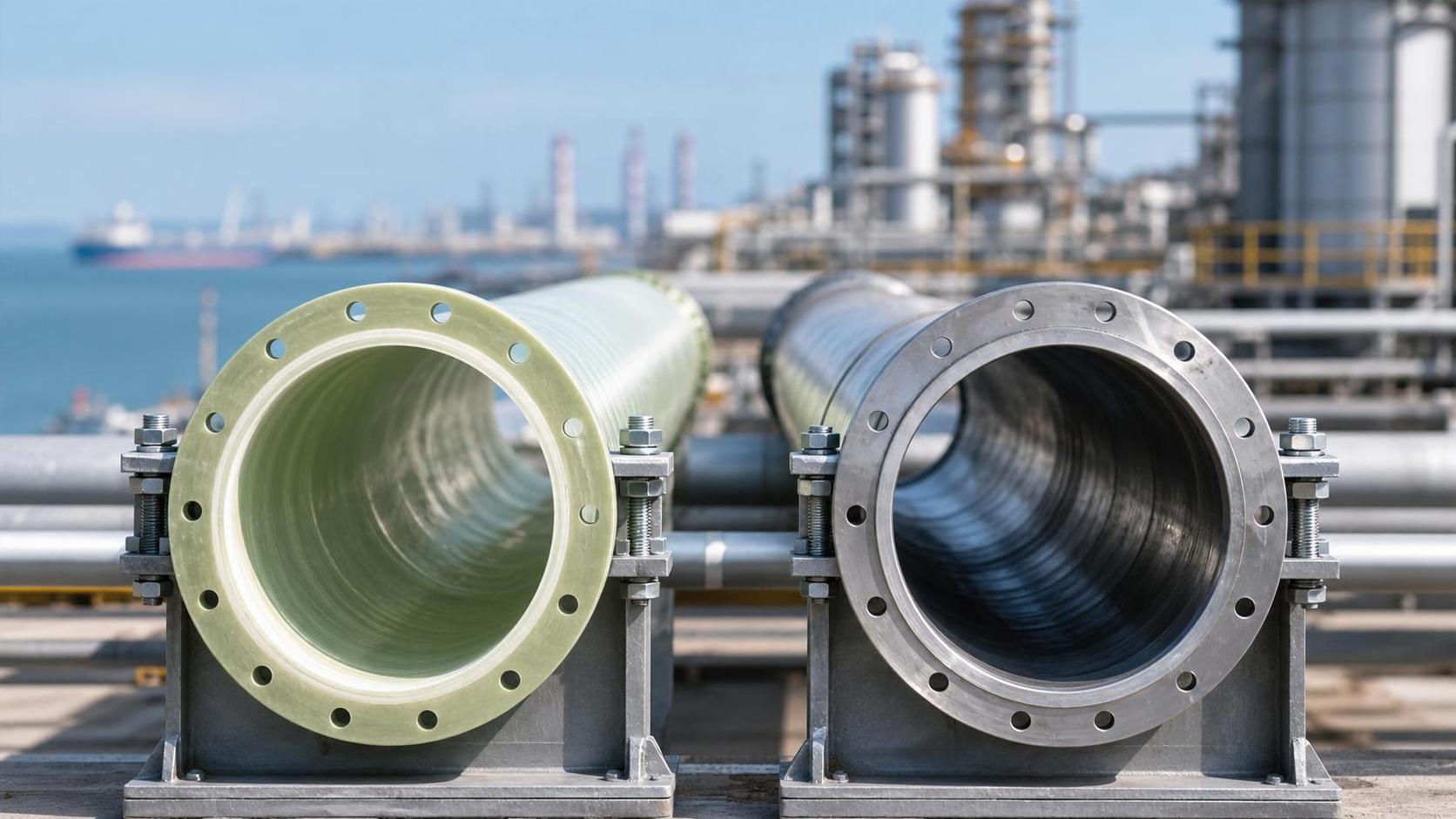
FRP Pipe vs Steel Pipe: Which Performs Better?
When comparing FRP Pipe with steel pipe for demanding industrial systems, technical decisions rarely come down to one metric.
Initial price matters, but long-term reliability often matters more.
Corrosion resistance, system weight, flow stability, maintenance frequency, and installation speed all shape final performance.
In oil and gas, chemical plants, marine ballast systems, LNG lines, and hot spring transport, the wrong material choice can create costly downtime.
Understanding the Basic Difference
Steel pipe is a traditional option with high mechanical strength and wide market familiarity.
FRP Pipe, including GRE systems, combines glass fiber reinforcement with a resin matrix.
That structure gives FRP Pipe a very different performance profile.
Instead of competing only on strength, FRP Pipe often wins through corrosion control, lower weight, and reduced lifecycle intervention.
Corrosion Resistance: The Biggest Performance Divider
If the medium is corrosive, FRP Pipe usually has the advantage.
Steel pipe can perform well, but it often needs coating, lining, cathodic protection, or chemical treatment support.
Those protections add cost and also create future inspection work.
FRP Pipe handles saline water, many chemicals, humid environments, and sour service conditions with far less corrosion concern.
This is especially relevant in marine piping, chemical processing, and produced water systems.
In real projects, corrosion resistance is often the reason FRP Pipe moves from alternative option to preferred option.
Where steel still stays competitive
Steel remains practical when corrosion exposure is limited and inspection access is easy.
It can also remain attractive for short lifecycle projects where long-term maintenance is not the main concern.
Weight, Handling, and Installation Efficiency
One of the clearest day-to-day benefits of FRP Pipe is lower weight.
Compared with steel pipe, FRP Pipe is much easier to transport, lift, align, and install.
That matters on offshore platforms, shipyards, elevated pipe racks, and remote construction sites.
Lower weight can reduce crane time, labor intensity, and support structure demand.
So even when material price seems higher, installed project cost may become more competitive.
- Faster field handling reduces schedule pressure.
- Lighter systems may simplify support design.
- Lower installation complexity can reduce risk of delays.
Pressure and Temperature: Not a One-Line Answer
Steel pipe is often seen as the safe choice for very high pressure and very high temperature service.
That reputation is deserved in extreme operating windows.
Still, modern FRP Pipe is not limited to low-demand applications.
Well-engineered GRE systems can manage challenging hydrocarbon and industrial process conditions.
Material selection depends on pressure class, temperature range, medium composition, cyclic loading, and joining method.
This is where specification discipline matters more than general assumptions.
For example, High Temperature GRE Pipe for Hydrocarbon Transportation with API Monogram fits applications where temperature resistance and hydrocarbon compatibility are key selection factors.
That kind of product shows how FRP Pipe has evolved well beyond basic utility service.
Flow Performance and Internal Surface Quality
Flow efficiency often gets less attention than it should.
FRP Pipe usually offers a smooth internal surface that resists scale buildup and internal corrosion products.
That helps maintain predictable flow over time.
Steel pipe can start with good hydraulic performance, but roughness may increase as corrosion or deposits develop.
In long pipelines and recirculating industrial loops, stable internal condition can translate into lower pumping penalties.
Maintenance and Lifecycle Cost
This is where many selection decisions shift.
A steel system may look economical at procurement stage, then become expensive during operation.
Recoating, corrosion inspection, thickness monitoring, leak repair, and shutdown management all add lifecycle cost.
FRP Pipe often lowers those recurring demands, especially in corrosive and wet service environments.
That does not mean zero maintenance, but it often means fewer interventions and better uptime confidence.
Application Fit: Where Each Material Makes Sense
The better performer depends on service conditions, not brand preference or old habits.
FRP Pipe is often stronger in these cases
- Seawater, brine, and ballast piping systems.
- Chemical plants with aggressive media.
- Oil and gas utility and produced water lines.
- Projects where low maintenance is a strategic target.
- Installations where weight reduction improves project economics.
Steel pipe is often stronger in these cases
- Very high temperature and very high pressure extremes.
- Impact-heavy environments with severe mechanical abuse.
- Systems where existing standards and operator practice strongly favor steel.
What to Check Before Final Selection
A sound decision starts with a realistic operating profile.
- Map the actual fluid chemistry, not just the general media name.
- Confirm continuous and upset temperature ranges.
- Review pressure cycles, surge events, and expected service life.
- Estimate installation constraints, including lifting and access limits.
- Compare lifecycle maintenance cost, not only purchase cost.
- Verify certification, production capacity, and quality control from the supplier.
This is also why supplier capability matters.
Shandong Ocean Pipe Technology Co., Ltd., established in 2012 in Shandong, China, is among the top large GRE pipe manufacturers in the country.
With 16 winding production lines and extensive testing capacity, the company supports demanding industrial applications at scale.
Its GRE solutions are used across oil and gas, ship ballast piping, LNG, chemical plants, hot spring transport, and salt production.
That project background is useful when evaluating whether FRP Pipe can meet both technical and operational expectations.
Final Verdict
If the application involves corrosion, weight sensitivity, and long service life, FRP Pipe often performs better than steel pipe.
If the duty pushes into extreme pressure and temperature territory, steel may still be the better fit.
The key is not choosing the familiar material.
The key is choosing the material that lowers total technical risk over the full operating life.
For many industrial systems, that analysis increasingly points toward FRP Pipe.
If hydrocarbon service and elevated temperature are part of the decision, reviewing High Temperature GRE Pipe for Hydrocarbon Transportation with API Monogram can be a practical next step.
Please give us a message
产品介绍产品介绍产品介绍产品介绍产品介绍产品介绍产品介绍产品介绍产品介绍产品介绍产品介绍产品介绍产品介绍产品介绍产品介绍产品介绍产品介绍产品介绍产品介绍产品介绍产品介绍产品介绍产品介绍产品介绍产品介绍产品介绍产品介绍产品介绍产品介绍产品介绍
Please give us a message
产品介绍产品介绍产品介绍产品介绍产品介绍产品介绍产品介绍产品介绍产品介绍产品介绍产品介绍产品介绍产品介绍产品介绍产品介绍产品介绍产品介绍产品介绍产品介绍产品介绍产品介绍产品介绍产品介绍产品介绍产品介绍产品介绍产品介绍产品介绍产品介绍产品介绍
Please give us a message
产品介绍产品介绍产品介绍产品介绍产品介绍产品介绍产品介绍产品介绍产品介绍产品介绍产品介绍产品介绍产品介绍产品介绍产品介绍产品介绍产品介绍产品介绍产品介绍产品介绍产品介绍产品介绍产品介绍产品介绍产品介绍产品介绍产品介绍产品介绍产品介绍产品介绍
Please give us a message
产品介绍产品介绍产品介绍产品介绍产品介绍产品介绍产品介绍产品介绍产品介绍产品介绍产品介绍产品介绍产品介绍产品介绍产品介绍产品介绍产品介绍产品介绍产品介绍产品介绍产品介绍产品介绍产品介绍产品介绍产品介绍产品介绍产品介绍产品介绍产品介绍产品介绍