
FRP Pipe Pressure Ratings Explained Simply
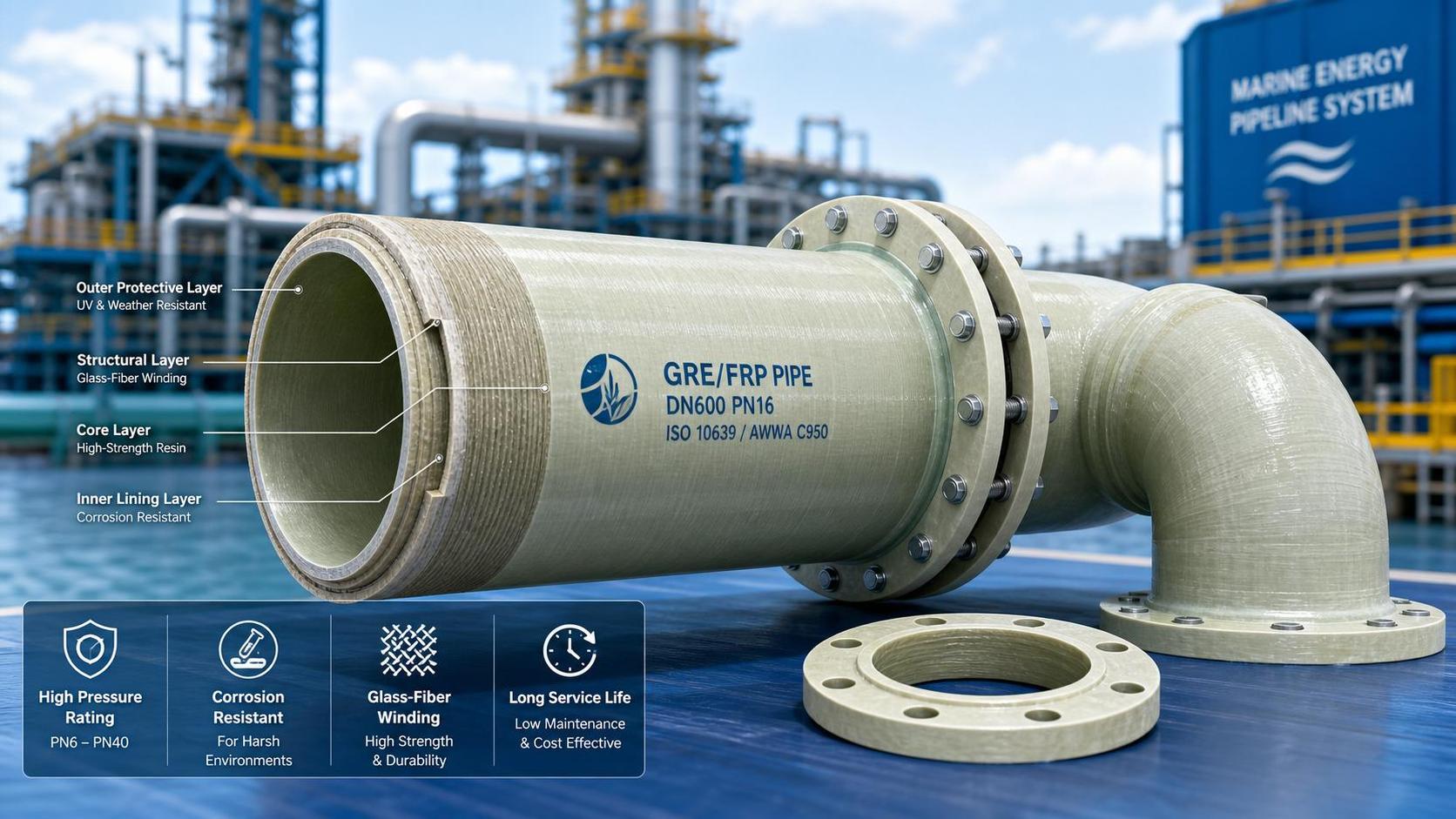
Understanding pressure ratings in FRP Pipe is easier when the focus stays on real operating conditions instead of technical jargon alone. In oil, gas, marine, chemical, and industrial systems, the pressure class of a pipe affects safety, service life, maintenance frequency, and confidence during daily operation. For glass fiber based piping materials such as GRE, a clear view of pressure ratings helps connect design data with practical decisions on site.
What a pressure rating really means
A pressure rating is the maximum internal pressure a pipe can handle under defined conditions. It is not a single number that applies to every temperature, fluid, or installation method.
With FRP Pipe, the rating depends on the composite structure. Glass fiber reinforcement carries strength, while the resin system supports chemical resistance, bonding, and temperature performance.
That is why two pipes with similar diameters may have different pressure classes. Their winding angle, wall thickness, resin type, and curing quality can all change the final result.
Why this matters in fiberglass and ceramic related industries
Within the broader glass and ceramic materials field, FRP Pipe stands out because it combines engineered fibers with corrosion resistant resin systems. It is not brittle like traditional ceramic components, yet it serves many aggressive media applications.
Pressure performance matters most where corrosion, salt exposure, temperature variation, or difficult media make steel less attractive. In these settings, pressure class is closely linked to reliability.
This is especially relevant in ballast lines, LNG support systems, hot spring pipelines, salt making operations, and chemical transport loops, where both pressure and corrosion must be considered together.
The main factors behind FRP Pipe pressure classes
Simple labels such as PN10 or PN16 are useful, but they only tell part of the story. Actual performance comes from a combination of material design and service conditions.
Wall structure and winding quality
Filament winding controls how fibers are placed around the pipe. Good alignment increases hoop strength, which directly supports internal pressure resistance.
If winding consistency changes, pressure capability can also change. This is why stable production equipment and controlled processing matter so much.
Resin system and temperature
As temperature rises, many composite systems lose some pressure carrying capacity. A pipe that performs well with cool water may need derating in hot hydrocarbon or chemical service.
For higher temperature duty, the resin system becomes critical. In that context, solutions such as High Temperature GRE Pipe for Hydrocarbon Transportation with API Monogram fit applications where pressure and thermal stability must work together.
Diameter, fittings, and joining points
The straight pipe is only one part of the pressure system. Elbows, tees, reducers, adhesive joints, laminating joints, and flanged connections must match the same pressure class.
In practice, system weakness often appears at fittings or poorly executed joints rather than in the main FRP Pipe run.
How pressure ratings are used in daily decisions
Pressure class selection is not only a design office task. It affects start-up procedures, pressure testing, shutdown planning, and replacement timing.
A practical approach is to compare operating pressure with transient pressure, test pressure, fluid temperature, and chemical exposure at the same time.
This wider view prevents a common mistake: choosing a pressure class from a catalog and assuming that installation details will take care of themselves.
Where pressure ratings become most critical
Not every pipeline faces the same level of risk. Some services are forgiving, while others leave very little margin for error.
- Hydrocarbon transport needs attention to pressure, temperature, and fire safety requirements.
- Ship ballast systems face vibration, saltwater exposure, and space limited routing.
- Chemical plant lines need resin compatibility as much as pressure capacity.
- Hot spring and geothermal water systems must consider elevated temperature over long cycles.
- Salt making operations often combine corrosive brine with continuous service demands.
In all of these cases, FRP Pipe is selected because corrosion resistance alone is not enough. The pipe must also keep stable pressure performance during real operation.
What reliable manufacturing adds to the rating
A pressure rating only has value when it is backed by consistent production and testing. This is where manufacturing capability becomes part of the technical discussion.
Shandong Ocean Pipe Technology Co., Ltd., established in 2012 in Dezhou, Shandong, has developed large scale GRE pipe capability with 16 winding production lines and 174 pipe fitting winding machines.
Its factory also uses five static water pressure testing machines, supporting annual production and testing capacity of 25,000 tons. For pressure rated systems, this matters because repeatability is as important as design intent.
Use across CNOOC, CNPC, Sinopec, major shipyards, and overseas markets also shows that FRP Pipe pressure performance is being judged in demanding environments, not only in laboratory conditions.
Common misunderstandings that create risk
Many pressure related problems begin with simple assumptions. The pipe may be technically suitable, but the system interpretation can still be wrong.
- Assuming room temperature ratings apply at all service temperatures.
- Ignoring water hammer or pump start pressure spikes.
- Matching straight pipe ratings but overlooking fitting pressure limits.
- Treating hydrotest pressure as a normal operating target.
- Choosing by initial cost without checking service life in corrosive media.
Usually, the safest choice is not the highest nominal rating. It is the rating that fits actual pressure behavior, media chemistry, and installation quality.
A practical way to evaluate the right FRP Pipe
A useful review starts with the service profile. Gather the pressure range, upset conditions, fluid type, temperature range, and layout constraints before comparing products.
Then check whether the pipe standard, resin system, joining method, and test records align with that profile. If the line handles hot hydrocarbons, the margin should be reviewed more carefully.
That is often the point where a specialized option, including High Temperature GRE Pipe for Hydrocarbon Transportation with API Monogram , becomes relevant as a technical reference rather than a generic substitute.
The next step is straightforward: compare rated pressure with real operating data, verify fitting compatibility, and confirm test documentation. A sound FRP Pipe decision is usually built on that three part check.
Please give us a message
产品介绍产品介绍产品介绍产品介绍产品介绍产品介绍产品介绍产品介绍产品介绍产品介绍产品介绍产品介绍产品介绍产品介绍产品介绍产品介绍产品介绍产品介绍产品介绍产品介绍产品介绍产品介绍产品介绍产品介绍产品介绍产品介绍产品介绍产品介绍产品介绍产品介绍
Please give us a message
产品介绍产品介绍产品介绍产品介绍产品介绍产品介绍产品介绍产品介绍产品介绍产品介绍产品介绍产品介绍产品介绍产品介绍产品介绍产品介绍产品介绍产品介绍产品介绍产品介绍产品介绍产品介绍产品介绍产品介绍产品介绍产品介绍产品介绍产品介绍产品介绍产品介绍
Please give us a message
产品介绍产品介绍产品介绍产品介绍产品介绍产品介绍产品介绍产品介绍产品介绍产品介绍产品介绍产品介绍产品介绍产品介绍产品介绍产品介绍产品介绍产品介绍产品介绍产品介绍产品介绍产品介绍产品介绍产品介绍产品介绍产品介绍产品介绍产品介绍产品介绍产品介绍
Please give us a message
产品介绍产品介绍产品介绍产品介绍产品介绍产品介绍产品介绍产品介绍产品介绍产品介绍产品介绍产品介绍产品介绍产品介绍产品介绍产品介绍产品介绍产品介绍产品介绍产品介绍产品介绍产品介绍产品介绍产品介绍产品介绍产品介绍产品介绍产品介绍产品介绍产品介绍