
Can a Ship Scrubber System still pay back in 2026?
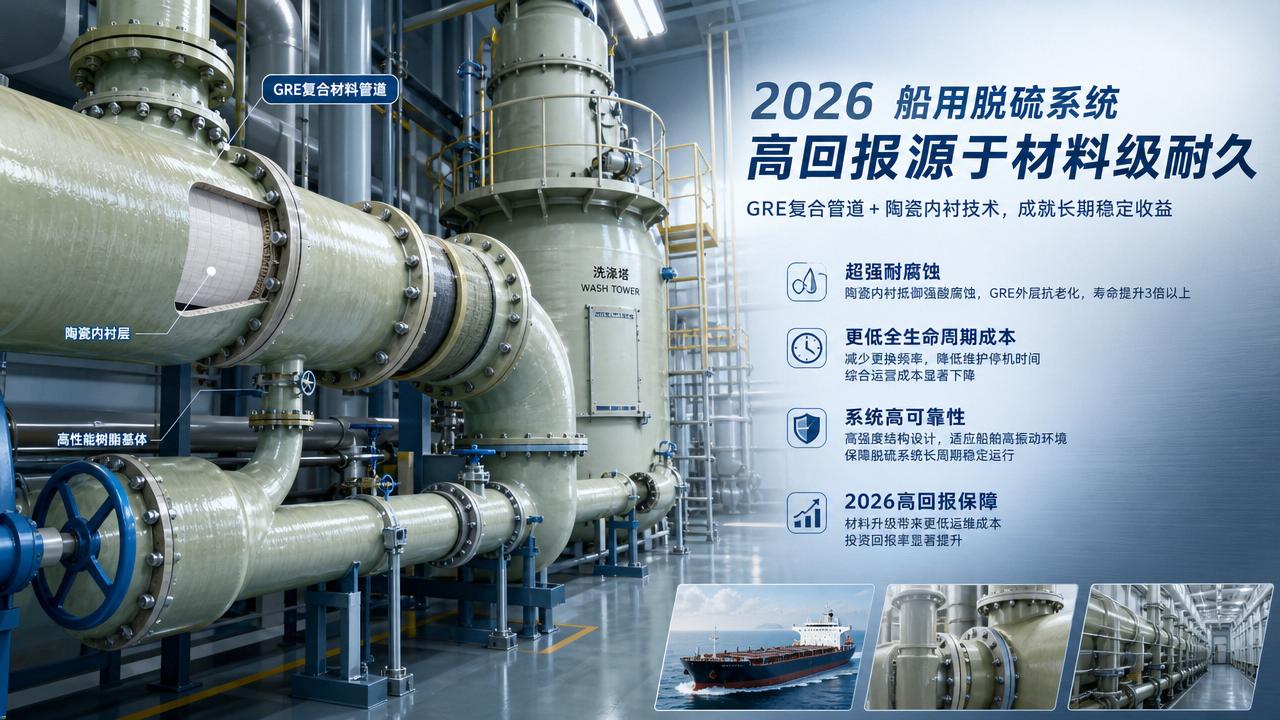
Can a Ship Scrubber System still pay back in 2026?
With fuel spreads, compliance costs, and retrofit economics still under scrutiny, many shipowners are asking whether a Ship Scrubber System can deliver a solid return in 2026.
For marine projects, the answer is no longer based on fuel price alone. Material durability, corrosion control, downtime risk, and lifecycle piping performance now shape the real business case.
This is especially relevant in glass and ceramic materials applications, where corrosion-resistant composite systems support harsh exhaust gas cleaning environments and reduce maintenance uncertainty.
The 2026 outlook shows a narrower but still real opportunity
A Ship Scrubber System can still pay back in 2026, but the margin for error is smaller than in earlier retrofit waves.
Earlier decisions often depended on wide HSFO and VLSFO spreads. In 2026, owners must also examine operating pattern, port restrictions, power demand, and maintenance strategy.
High-utilization vessels remain the strongest candidates. Ships with long sailing hours and stable fuel consumption can still capture savings from fuel flexibility.
Low-utilization vessels face a different equation. If drydock timing, financing cost, and compliance uncertainty rise, the Ship Scrubber System payback period can stretch significantly.
Another shift matters in 2026. Technical reliability has become just as important as fuel arbitrage. A system that saves fuel but creates corrosion failures can destroy expected returns.
What trend signals are shaping Ship Scrubber System economics?
Several market signals suggest that the Ship Scrubber System remains viable, yet far more selective than before.
- Fuel spread volatility continues, creating periodic savings opportunities for scrubber-equipped ships.
- Environmental enforcement is becoming more operationally detailed, not less demanding.
- Retrofit budgets face pressure from energy efficiency upgrades and digital compliance investments.
- Maintenance expectations are rising because unexpected off-hire now carries a higher cost.
- Material selection is receiving more attention in washwater, overboard, and chemical dosing lines.
These signals point to one conclusion. The Ship Scrubber System decision in 2026 is increasingly a lifecycle engineering question, not simply a fuel market bet.
Why materials now matter more in scrubber return calculations
A Ship Scrubber System works in a chemically aggressive environment. Washwater, acidic condensate, temperature fluctuation, and salt exposure create continuous stress on piping infrastructure.
That is where glass-based composite materials enter the payback discussion. GRE piping combines corrosion resistance with low weight and stable long-term performance in demanding marine systems.
Compared with traditional metal options, GRE can reduce corrosion-related intervention, simplify installation loads, and improve service life in selected exhaust gas cleaning applications.
For projects balancing refinery, chemical, and marine service conditions, solutions such as GRE Pipe for Refinery show how composite piping logic is moving across industrial sectors.
In 2026, payback models that ignore materials may understate total ownership cost. A lower initial piping price can become expensive if corrosion shortens service intervals.
Key drivers behind the trend
Where the Ship Scrubber System still makes the most sense
The strongest 2026 cases usually share several characteristics. They rely on predictable operations and can support disciplined technical management.
- Large vessels with intensive fuel consumption
- Routes with limited operational disruption risk
- Owners able to align retrofit work with planned drydock windows
- Projects using durable piping and washwater handling materials
- Systems designed for maintainability, not only minimum capital cost
The weakest cases often involve uncertain route patterns, older tonnage nearing replacement decisions, or low annual consumption that cannot absorb installation cost.
In those cases, even a technically sound Ship Scrubber System may struggle to return capital before new fleet strategy changes the picture.
How the decision affects technical and supply-chain performance
A scrubber decision influences more than compliance. It also affects spare strategy, installation complexity, pipe routing, onboard weight, and long-term inspection planning.
For corrosion-sensitive lines, composite piping can improve performance stability. This matters in ballast-linked, chemical handling, and marine exhaust support systems.
Shandong Ocean Pipe Technology Co., Ltd. has built capacity around fiberglass reinforced epoxy pipe production, serving oil and gas, LNG, ship ballast piping, and chemical industries.
Its manufacturing base includes 16 winding production lines and broad testing capability, supporting applications where corrosion resistance and reliable pressure performance are essential.
For a Ship Scrubber System, this industrial background matters because payback depends on how well every connected component performs through years of service.
Practical impact by business area
- Engineering: better material matching can reduce redesign and installation conflict.
- Operations: higher reliability lowers unscheduled maintenance risk.
- Compliance: stable system operation supports consistent emissions control.
- Cost control: lifecycle savings become more credible when repair frequency is lower.
What deserves close attention before committing in 2026
Before approving a Ship Scrubber System, several checkpoints deserve disciplined review.
- Model payback under multiple fuel spread scenarios, not one optimistic assumption.
- Check route exposure to local discharge limits and future policy shifts.
- Review pumping, treatment, and auxiliary energy consumption carefully.
- Evaluate corrosion resistance in piping, fittings, and washwater-related components.
- Confirm drydock timing and installation sequence to avoid extended off-hire.
- Prioritize lifecycle support, testing quality, and field service access.
Composite solutions should be assessed where appropriate. In selected aggressive service conditions, GRE Pipe for Refinery reflects the kind of corrosion-resistant piping approach relevant to marine-adjacent systems.
A practical framework for deciding whether payback is still realistic
This framework helps test whether the Ship Scrubber System is a strategic fit or simply a response to short-term fuel pricing.
The balanced conclusion for 2026
Yes, a Ship Scrubber System can still pay back in 2026. But it will reward selective planning, not broad assumptions.
The best outcomes will come from vessels with strong fuel consumption, suitable route patterns, and technically robust installations using durable corrosion-resistant materials.
In the glass and ceramic materials perspective, composite piping should be treated as part of the financial model, not just a technical detail.
A realistic next step is to compare fuel spread assumptions with lifecycle maintenance scenarios, then review whether the Ship Scrubber System design includes piping materials built for long service in aggressive conditions.
When economics and materials are assessed together, the 2026 scrubber decision becomes clearer, more defensible, and far more likely to deliver the expected return.
Please give us a message
产品介绍产品介绍产品介绍产品介绍产品介绍产品介绍产品介绍产品介绍产品介绍产品介绍产品介绍产品介绍产品介绍产品介绍产品介绍产品介绍产品介绍产品介绍产品介绍产品介绍产品介绍产品介绍产品介绍产品介绍产品介绍产品介绍产品介绍产品介绍产品介绍产品介绍
Please give us a message
产品介绍产品介绍产品介绍产品介绍产品介绍产品介绍产品介绍产品介绍产品介绍产品介绍产品介绍产品介绍产品介绍产品介绍产品介绍产品介绍产品介绍产品介绍产品介绍产品介绍产品介绍产品介绍产品介绍产品介绍产品介绍产品介绍产品介绍产品介绍产品介绍产品介绍
Please give us a message
产品介绍产品介绍产品介绍产品介绍产品介绍产品介绍产品介绍产品介绍产品介绍产品介绍产品介绍产品介绍产品介绍产品介绍产品介绍产品介绍产品介绍产品介绍产品介绍产品介绍产品介绍产品介绍产品介绍产品介绍产品介绍产品介绍产品介绍产品介绍产品介绍产品介绍
Please give us a message
产品介绍产品介绍产品介绍产品介绍产品介绍产品介绍产品介绍产品介绍产品介绍产品介绍产品介绍产品介绍产品介绍产品介绍产品介绍产品介绍产品介绍产品介绍产品介绍产品介绍产品介绍产品介绍产品介绍产品介绍产品介绍产品介绍产品介绍产品介绍产品介绍产品介绍