
GRE Pipe Market Outlook: How Composite Solutions Are Replacing Steel in Harsh Chemical Environments by 2027
A Market Shift That Has Been Building for Years
The corrosion problem in oil and gas infrastructure is not new. Neither is the search for something better than carbon steel. What has changed, though, is the pace at which operators and engineering contractors are willing to switch materials. For decades, steel was the default choice because it was familiar, well-documented, and easy to source. But the cost of corrosion — both in maintenance and downtime — has become harder to justify, especially in environments where the service conditions are known to be aggressive from day one.
By 2027, the market outlook for fiberglass reinforced epoxy (GRE) pipe suggests a clear trajectory: composite solutions are not just an alternative anymore. They are becoming the preferred specification for harsh chemical environments, particularly in oilfields where water cut is high, where CO2 and H2S are present, and where the logistics of replacing failed steel lines are punishing.
This is not a prediction that steel disappears. Far from it. Steel still carries a massive share of the market for high-pressure gas transmission and other demanding services. But for the segment of infrastructure that has to survive contact with brine, sour crude, and chemical injection lines, the economics have quietly turned in favor of composite piping. And the trend is accelerating.
Why Steel Keeps Failing in These Applications
Anyone who has managed a production facility for more than a few years knows the pattern. A new carbon steel line goes in, the corrosion allowance looks acceptable on paper, and then the reality of the produced fluid starts to bite. Pitting. Erosion-corrosion at elbows. Weld attack. Scale buildup that actually accelerates localized corrosion underneath. The result is a maintenance cycle that becomes a permanent drain on the operations budget.
The usual mitigation measures — chemical inhibition programs, periodic inspection, lined steel — all add cost and complexity. Inhibition requires continuous monitoring and dosing infrastructure. Inspection on offshore platforms or remote desert locations is expensive. And lined steel still relies on the mechanical integrity of the outer shell, which can be compromised by external corrosion over time.
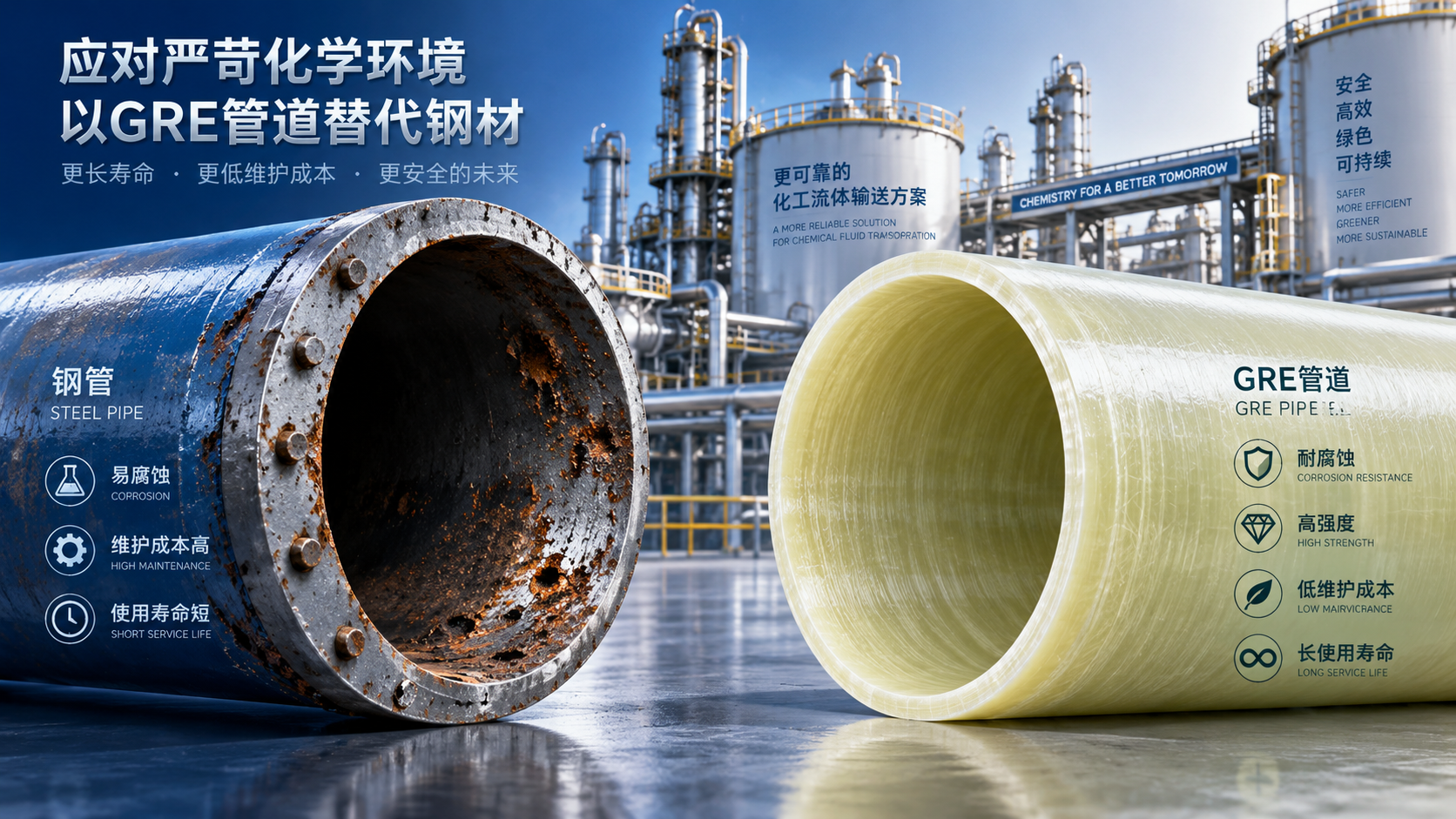
In contrast, GRE pipe does not corrode. The epoxy resin system and fiberglass structure are inherently resistant to the chemical attack that destroys steel from the inside out. That single difference changes the entire cost equation over the life of the asset. Instead of planning for replacement in five to eight years, operators can reasonably expect service life measured in decades, provided the pipe is selected and installed correctly.
What the 2027 Outlook Actually Depends On
Forecasts about market share and adoption rates make for useful planning context, but the real drivers are more practical. Three factors will determine how quickly composite replacement gains ground in harsh chemical environments.
The first is qualification. Engineering standards now cover GRE piping for oil and gas service more comprehensively than they did a decade ago. When a manufacturer can document compliance with API 15HR or similar specifications, project teams feel more comfortable moving away from steel. The availability of documented performance data removes the uncertainty that used to stall material substitution decisions.
The second factor is installation competence. GRE pipe requires different handling than steel. Proper adhesive application, correct curing times, and attention to thermal expansion characteristics are all critical. Projects where the installation contractor understands composite materials tend to have trouble-free experiences. Those who treat GRE like a drop-in steel replacement may encounter problems. This is less about the product and more about the skill of the crew.
The third factor is supply chain reliability. In oilfield projects, material lead times can make or break a schedule. A manufacturer with dedicated production capacity and a track record of on-time delivery becomes a strategic partner, not just a vendor. This is one area where the industry is seeing a clear advantage for established Chinese manufacturers who have invested heavily in capacity and quality systems.
Where GRE Pipe Is Winning Right Now
Looking at actual applications across the oil and gas sector, several patterns emerge. In water injection lines, GRE has become a mainstream choice. The combination of high salinity, dissolved oxygen, and continuous operation makes steel a poor economic choice. Produced water handling lines offer a similar story. When the water cut rises above a certain percentage, corrosion management on steel lines becomes increasingly expensive.
Chemical injection lines are another clear fit. Methanol, corrosion inhibitors, scale preventatives — these fluids are often aggressive on their own, and the small diameters involved make steel lines particularly vulnerable to premature failure. GRE handles these services with minimal degradation.
Fire water systems and cooling water loops also favor GRE. The lower weight means reduced structural support requirements, and the smooth internal bore means lower pumping costs over the life of the system. For seawater intake and discharge lines, the corrosion resistance is almost a necessity rather than an option.
Ship ballast piping is a similar case. Vessels operating in harsh marine environments face constant corrosion pressure. Several major Chinese shipyards have standardized on GRE for ballast lines, which speaks to the acceptance of these materials in demanding marine service.
The Manufacturer's Role in Driving Adoption
Material substitution at scale requires more than a good product. It requires a manufacturer that can deliver consistent quality across large volumes and varied specifications. This is where the market is consolidating around producers with proven production depth.
Shandong Ocean Pipe Technology, established in 2012 in Dezhou's Wucheng Industrial Park, represents a good example of the capacity that this market now requires. With 16 winding production lines and another 174 sets of pipe fitting winding machines, the manufacturer can handle both large-diameter transmission lines and the smaller fitting pieces that often become the weak point in piping systems. The presence of five static water pressure testing machines and an annual production and testing capacity of 25,000 tons means that quality verification is built into the workflow, not exported to a separate facility.
The customer list is telling. Work with CNOOC, CNPC, and Sinopec in the domestic Chinese market, plus shipbuilding operations like Shanghai Waigaoqiao, provides experience across the harshest environments. Expanding into markets such as Australia, Iraq, Kazakhstan, and Turkey gives a sense of how these products are traveling well beyond their home region. This kind of background matters because a durable GRE pipe supplier is not just selling a commodity — the supplier is selling predictability and performance under conditions where failure has real economic consequences.
What Should Decision-Makers Watch For
For those planning infrastructure projects in the 2025-2027 window, a few practical recommendations are worth considering.
First, do not assume that GRE is the right answer for every line. High-temperature service above the rating of the resin system, extreme pressure conditions, or services involving certain solvents may still demand metallic piping. The key is to assess each service condition against the documented performance envelope of the GRE product being considered.
Second, involve the pipe manufacturer early in the design process. Application engineers can help with support spacing calculations, thermal expansion considerations, and end connection selections. These details — often overlooked in preliminary design — become deciding factors in installation success.
Third, compare the full lifecycle cost, not just the initial material cost. Steel has a lower first cost in most markets. GRE takes the lead when you include installation labor, corrosion monitoring, chemical treatment programs, and expected replacement cycles. For remote facilities where transportation and mobilization costs are steep, the advantage of composite materials grows even larger.
Fourth, verify the manufacturer's testing capacity and quality procedures. In the GRE industry, consistency depends on process control. A supplier that tests every batch under static water pressure, as facilities like Ocean Pipe do, offers a level of assurance that reduces project risk. The physics of composite materials mean that small manufacturing variations can have outsized effects on performance.
Finally, make sure the installation contractor is trained specifically on composite pipe. This cannot be emphasized enough. The most common field failures in GRE lines are traced back to improper bonding or rough handling during installation. A good manufacturer will offer technical guidance or connect you with qualified installers in your region.
The market direction is clear. Corrosion management budgets across the oil and gas industry are being reviewed with fresh eyes. The cost of maintaining steel infrastructure in aggressive environments is no longer a fixed expense that nobody questions. It is a target for operational efficiency, and composite piping is one of the most direct ways to remove that cost line from the budget.
By the time the 2027 outlook arrives, the question is unlikely to be whether GRE can replace steel in harsh chemical environments. In many projects, that decision will already have been made. The challenge will be managing the scale of this transition — and having production capacity that can keep up with demand.
Related Posts
- ▶ GRE Pipe Market Outlook: How Composite Solutions Are Replacing Steel in Harsh Chemical Environments by 2027
- ▶ Cutting and Beveling Durable GRE Pipe on Site: Recommended Tooling to Prevent Edge Delamination
- ▶ Durable GRE Pipe Supplier Qualification Checklist: What Auditors Look for in Fiberglass Manufacturers
Please give us a message
产品介绍产品介绍产品介绍产品介绍产品介绍产品介绍产品介绍产品介绍产品介绍产品介绍产品介绍产品介绍产品介绍产品介绍产品介绍产品介绍产品介绍产品介绍产品介绍产品介绍产品介绍产品介绍产品介绍产品介绍产品介绍产品介绍产品介绍产品介绍产品介绍产品介绍
Please give us a message
产品介绍产品介绍产品介绍产品介绍产品介绍产品介绍产品介绍产品介绍产品介绍产品介绍产品介绍产品介绍产品介绍产品介绍产品介绍产品介绍产品介绍产品介绍产品介绍产品介绍产品介绍产品介绍产品介绍产品介绍产品介绍产品介绍产品介绍产品介绍产品介绍产品介绍
Please give us a message
产品介绍产品介绍产品介绍产品介绍产品介绍产品介绍产品介绍产品介绍产品介绍产品介绍产品介绍产品介绍产品介绍产品介绍产品介绍产品介绍产品介绍产品介绍产品介绍产品介绍产品介绍产品介绍产品介绍产品介绍产品介绍产品介绍产品介绍产品介绍产品介绍产品介绍
Please give us a message
产品介绍产品介绍产品介绍产品介绍产品介绍产品介绍产品介绍产品介绍产品介绍产品介绍产品介绍产品介绍产品介绍产品介绍产品介绍产品介绍产品介绍产品介绍产品介绍产品介绍产品介绍产品介绍产品介绍产品介绍产品介绍产品介绍产品介绍产品介绍产品介绍产品介绍