
Durable GRE Pipe Supplier Qualification Checklist: What Auditors Look for in Fiberglass Manufacturers
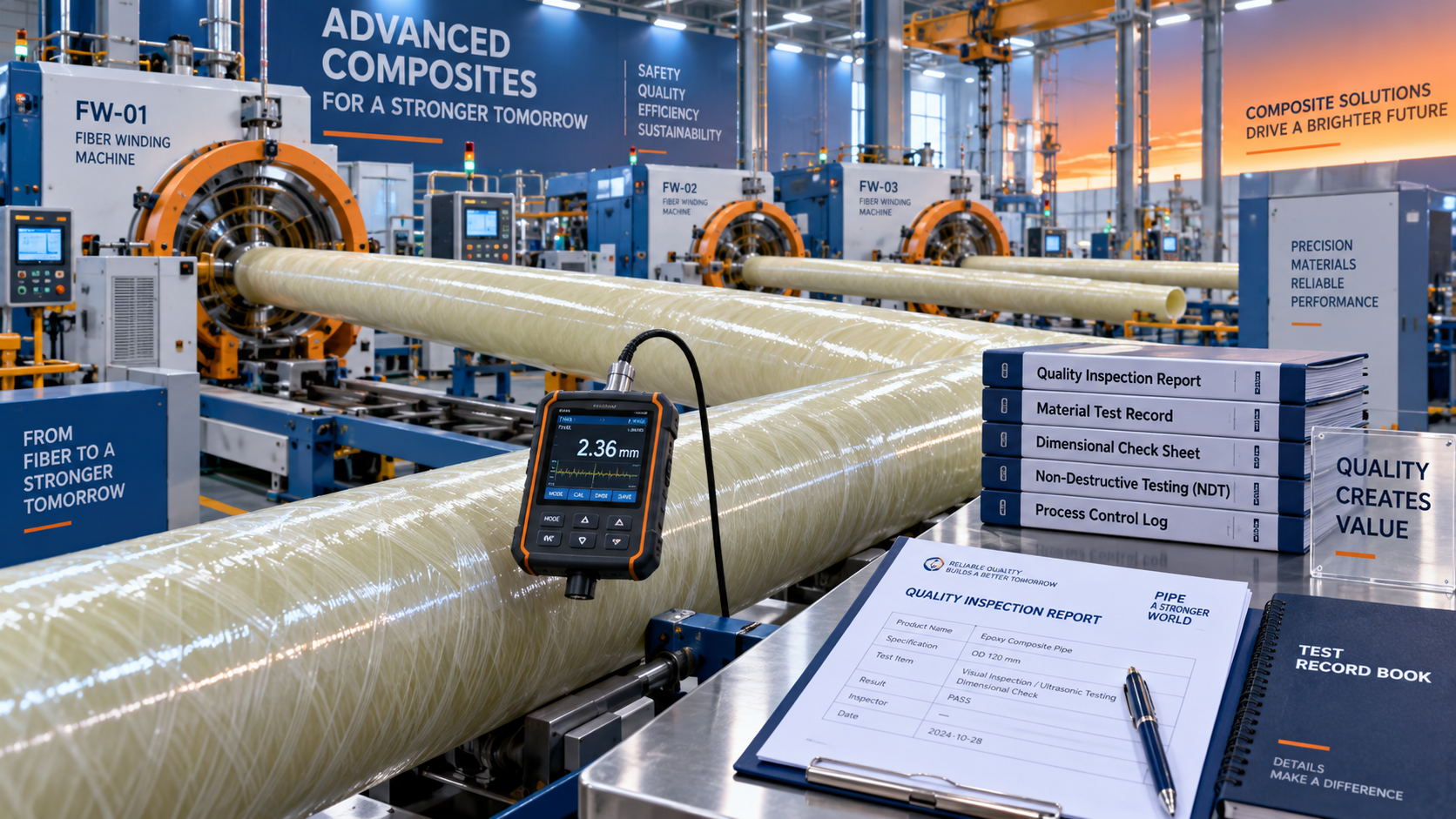
What a Durable GRE Pipe Supplier Audit Actually Checks
Procurement teams sourcing fiberglass reinforced epoxy (GRE) pipe for oil and gas projects face a common problem: every manufacturer claims durability, but few can prove it under audit conditions. The supplier qualification process exists to separate marketing language from manufacturing reality. Before you approve any vendor for your approved manufacturer list, you need to know what a serious auditor walks in looking for—and what gets a factory rejected on the first pass.
The short version: auditors are not primarily looking at the pipe itself. They are looking at the systems that produce the pipe. Durability in GRE pipe is a function of process control, material traceability, and testing discipline. A factory with older winding lines but rigorous documentation will often pass where a newer facility with sloppy record-keeping fails. This is the first mental shift buyers need to make.
Production Capacity Is a Risk Indicator, Not a Bragging Point
When an auditor reviews a fiberglass manufacturer, the number of winding lines and annual tonnage figures are evaluated differently than how they appear in a brochure. High capacity is not inherently good or bad—it is a data point that tells the auditor how the factory handles demand fluctuations, order conflicts, and quality consistency across parallel production lines.
A manufacturer running 16 winding lines with 174 fitting winding machines—numbers in the range of what larger Chinese GRE pipe producers operate—faces a coordination problem that smaller shops do not. The auditor wants to see how the factory prevents one line's production issues from contaminating another line's output. Questions at this stage typically include:
- How are raw material batches allocated across multiple winding lines?
- What happens when one line has a process deviation—does production stop, or does the line continue while the issue is logged?
- How are resin mixing parameters verified between shifts?
- Is there a clear separation between pipe production and fitting production in terms of quality control?
For buyers, this matters because a durable GRE pipe is only as reliable as the consistency of its manufacturing process. A factory that can produce 25,000 tons annually but cannot demonstrate consistent process parameters across all lines carries more risk than a smaller manufacturer with tighter control. Do not be impressed by scale—be impressed by how scale is managed.
The Testing Protocol Reveals More Than the Test Results
Static water pressure testing is standard in the industry, but auditors pay close attention to how tests are conducted and what triggers a retest. A manufacturer with five static water pressure testing machines—again, a common scale for top-tier Chinese producers—needs to show not just that tests happen, but that the test frequency is tied to production risk.
Key audit points in this area include:
- Are pressure tests performed on every pipe, or on samples? If sampling, what is the sampling rate and how is it determined?
- What is the pass/fail criterion for a pressure test, and who has authority to reject a pipe?
- Is there a documented procedure for what happens after a test failure—is the entire batch quarantined, or only the specific pipe?
- How are test records linked to individual pipes for traceability purposes?
Auditors also look at whether the testing equipment itself is calibrated and whether calibration records are current. A factory that cannot demonstrate proper calibration of its testing machines has a quality system problem, regardless of how many machines it owns. The presence of equipment is not evidence of quality; the evidence lies in the records surrounding that equipment.
Traceability Systems Are Where Most Suppliers Fail
This is the area where the gap between qualified and unqualified manufacturers becomes most visible. A durable GRE pipe installed in an oil and gas project may need to be traced back to its raw material batch years after installation. If a problem emerges in the field, the manufacturer must be able to identify which resin batch, which glass fiber roll, which winding line, and which operator shift produced that specific pipe.
Auditors check for the following traceability elements:
- Unique pipe identification numbers that survive shipping and handling
- Raw material lot numbers recorded against each production batch
- Environmental conditions during winding (temperature, humidity) logged per batch
- Curing parameters tied to individual pipes or production runs
- Integration between production records and test results
Buyers should understand that traceability failures are rarely visible in the product itself. A pipe can be flawless and still fail an audit because the manufacturer cannot prove where it came from. If you are sourcing for projects with long lifecycles and potential liability exposure, traceability is arguably the most important single qualification criterion.
Certifications Must Be Verified, Not Collected
Every GRE pipe manufacturer will show you a list of certifications and standards compliance. Auditors look beyond the certificates themselves to understand how compliance is maintained. The key questions are about frequency and renewal:
- When was the last third-party audit conducted?
- What non-conformities were raised, and how were they addressed?
- Are certifications valid for the specific products you plan to purchase, or do they cover a broader product range that may not apply?
- Does the manufacturer have internal audit processes between external certification cycles?
It is also worth checking whether certifications correspond to the standards your project specifies. A manufacturer certified to general composite standards may not hold the specific API, ISO, or other industry-specific qualifications your project requires. The auditor's job is to match certification scope to project requirements, and buyers should do the same.
Practical Experience Matters More Than Brochure Claims
For oil and gas procurement specifically, application history is a meaningful signal that auditors evaluate alongside technical factors. A manufacturer that has supplied GRE pipe to offshore platforms, shipballast systems, or chemical plant piping has faced installation conditions that reveal design and manufacturing weaknesses. These are not the same as supplying pipe for water treatment or municipal applications.
Reference checks should be targeted, not general. Ask the manufacturer for projects that match your application category—if you are sourcing for LNG facilities, you want evidence of LNG-related supply, not just any industrial piping. An auditor will review project references, contact key customers (with permission), and look for patterns of repeat business. Repeat orders from established operators are a stronger signal than any single certificate.
Manufacturers like Shandong Ocean Pipe Technology, which has supplied major Chinese state energy groups and shipyards, carry application experience that can be verified across multiple sectors. But even that level of market presence does not substitute for a direct audit—it simply means the audit is more likely to uncover substantive information rather than basic gaps.
Red Flags That Should Stop the Approval Process
Certain findings during an audit are immediate disqualifiers, regardless of how competitive the pricing or how attractive the delivery schedule:
- No documented process for handling non-conforming products
- Test records that appear incomplete, illegible, or inconsistent with production volumes
- Raw material storage that does not meet resin and fiber manufacturer requirements
- No segregation of rejected materials from approved materials
- Inability to demonstrate that operators are trained and that training records are current
- Lack of a formal corrective action system for addressing quality complaints
Any of these findings suggests that the manufacturer's quality system exists on paper only. The cost of discovering this after pipes are delivered and installed is far higher than the cost of disqualifying a supplier during the audit phase.
What This Means for Your Procurement Process
The supplier qualification audit is not a bureaucratic hurdle—it is the most cost-effective risk management tool available in the GRE pipe procurement cycle. For oil and gas projects where pipe failure can result in operational shutdowns, environmental incidents, or safety hazards, the difference between a durable GRE pipe and a problematic one often lies not in the pipe itself but in the manufacturing discipline behind it.
Buyers should treat the audit as a two-way conversation rather than a one-way inspection. The audit is your opportunity to understand what you are actually purchasing, what limitations the manufacturer's process has, and what you need to specify in your purchase contract to protect your project's interests. Qualified suppliers welcome this level of scrutiny because their process can withstand it. Suppliers who resist detailed auditing or who cannot produce coherent documentation during the visit are telling you something that will cost you later if you ignore it.
Use the checklist above as a starting framework, but adapt it to your specific application requirements. The durability of GRE pipe in any project is ultimately a function of how well the manufacturer's capabilities align with your project's demands—and that alignment can only be verified through a disciplined, structured supplier qualification process.
Related Posts
Please give us a message
产品介绍产品介绍产品介绍产品介绍产品介绍产品介绍产品介绍产品介绍产品介绍产品介绍产品介绍产品介绍产品介绍产品介绍产品介绍产品介绍产品介绍产品介绍产品介绍产品介绍产品介绍产品介绍产品介绍产品介绍产品介绍产品介绍产品介绍产品介绍产品介绍产品介绍
Please give us a message
产品介绍产品介绍产品介绍产品介绍产品介绍产品介绍产品介绍产品介绍产品介绍产品介绍产品介绍产品介绍产品介绍产品介绍产品介绍产品介绍产品介绍产品介绍产品介绍产品介绍产品介绍产品介绍产品介绍产品介绍产品介绍产品介绍产品介绍产品介绍产品介绍产品介绍
Please give us a message
产品介绍产品介绍产品介绍产品介绍产品介绍产品介绍产品介绍产品介绍产品介绍产品介绍产品介绍产品介绍产品介绍产品介绍产品介绍产品介绍产品介绍产品介绍产品介绍产品介绍产品介绍产品介绍产品介绍产品介绍产品介绍产品介绍产品介绍产品介绍产品介绍产品介绍
Please give us a message
产品介绍产品介绍产品介绍产品介绍产品介绍产品介绍产品介绍产品介绍产品介绍产品介绍产品介绍产品介绍产品介绍产品介绍产品介绍产品介绍产品介绍产品介绍产品介绍产品介绍产品介绍产品介绍产品介绍产品介绍产品介绍产品介绍产品介绍产品介绍产品介绍产品介绍