
What should you ask before sourcing GRE pipe for offshore?
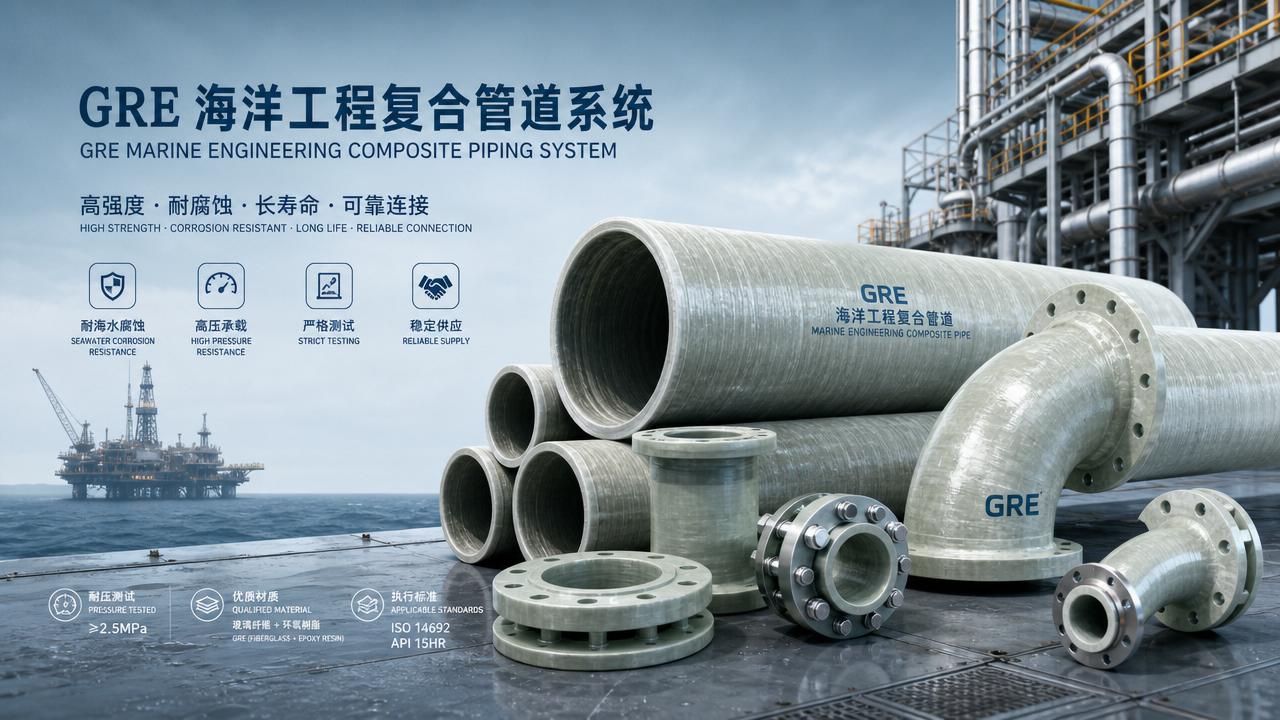
Before sourcing GRE pipe for offshore projects, it is essential to look beyond initial price and focus on technical fit, compliance, durability, and supply reliability. The right questions help verify whether a GRE pipe for offshore service can resist seawater, survive pressure cycles, and perform safely over a long operating life. A disciplined review also reduces maintenance exposure, shutdown risk, and total lifecycle cost in harsh marine conditions.
Why a checklist matters before buying GRE pipe for offshore use
GRE systems belong to the broader field of advanced glass-based composite materials. Their performance depends on glass fiber quality, epoxy resin selection, winding control, curing stability, and testing discipline.
In offshore environments, a poor selection can lead to leakage, delamination, joint failure, or chemical attack. A structured checklist makes technical comparison easier and supports a better sourcing decision.
When reviewing a GRE pipe for offshore project, the goal is not only to confirm product compliance. It is also to confirm the supplier’s ability to deliver consistent quality at scale.
Core checklist: what should you ask first
- Confirm applicable standards and approvals, including offshore, marine, fire performance, pressure testing, and material qualification documents relevant to the operating region and project specification.
- Ask which resin system is used and verify its compatibility with seawater, ballast water, hydrocarbons, chemicals, and expected operating temperatures over the full service life.
- Check pressure ratings carefully, including design pressure, surge pressure, vacuum resistance, cyclic loading limits, and safety factors used during engineering and testing.
- Review the glass fiber structure, winding angle, wall construction, and liner design because these determine hoop strength, stiffness, and long-term corrosion resistance.
- Request hydrostatic test records, burst test data, stiffness test results, and quality traceability reports for both pipes and fittings from recent production batches.
- Verify joining methods such as adhesive bonded joints, laminated joints, or mechanical connections, and ask how each option performs during installation offshore.
- Examine fitting capacity as closely as pipe capacity, because bends, tees, reducers, and flanges often control schedule risk and system reliability.
- Ask about production scale, machine quantity, and annual tonnage to confirm whether the supplier can support phased deliveries without sacrificing consistency.
- Review inspection procedures for raw materials, winding parameters, curing control, dimensional tolerance, and final testing to understand how defects are prevented.
- Confirm offshore project references and request examples involving ballast piping, fire water, cooling water, process lines, or corrosive utility services.
Key technical questions that separate good from risky options
Material composition and corrosion resistance
Not every GRE pipe for offshore conditions uses the same resin chemistry or laminate design. Ask whether the pipe is built for continuous seawater contact, splash-zone exposure, or intermittent chemical service.
A strong answer should explain inner liner structure, corrosion barrier thickness, glass content, and curing quality. These details matter because offshore service combines salt, temperature variation, and vibration.
Pressure, temperature, and fatigue performance
Pressure class alone is not enough. Offshore lines often see pump starts, transient spikes, and cyclic pressure loading. Ask for long-term hydrostatic basis and operating temperature derating guidance.
If the system carries warm seawater, produced water, or chemical mixtures, performance margins become critical. Reliable GRE pipe for offshore service should be supported by tested design data, not assumptions.
Manufacturing control and repeatability
Composite pipe quality depends heavily on process control. Ask how winding tension, resin ratio, curing temperature, and dimensional tolerances are monitored on each production line.
A supplier with multiple winding lines and dedicated fitting machines can often manage complex offshore packages more reliably. This matters where large quantities and many spool combinations are required.
How application scenario changes the questions
Ballast and seawater systems
For ballast and seawater lines, corrosion resistance is usually the first reason to choose GRE pipe for offshore installation. Focus on seawater compatibility, anti-permeation structure, and long-term internal surface stability.
Also ask about flange compatibility, onboard installation tolerances, and fitting availability. In marine construction, schedule delays often come from missing fittings rather than straight pipes.
Oil, gas, and chemical utility lines
Where process media may include hydrocarbons or treatment chemicals, resin resistance must be verified against actual composition. Ask for chemical resistance evidence rather than general statements.
If the package includes utility or auxiliary lines near heavy industrial services, experience from sectors such as Mining can also indicate familiarity with abrasive or corrosive operating conditions.
Fire water and safety-critical lines
Safety-related systems require stricter review. Ask whether the GRE pipe for offshore fire water duty meets project fire performance rules, impact requirements, and emergency service expectations.
Also check whether testing covers joints and fittings, not only pipe bodies. In real systems, connection points usually carry the highest installation and service risk.
Commonly overlooked risks
- Ignore installation conditions. Offshore assembly space is limited, so jointing method, cure time, and alignment tolerance should be reviewed before ordering.
- Overlook fitting lead times. A complete GRE pipe for offshore package depends on elbows, tees, reducers, flanges, and custom pieces arriving together.
- Assume all test reports are equivalent. Ask whether records come from actual production lots or only from historical type testing.
- Miss traceability details. Each spool, fitting, and flange should be linked to material batches, inspections, and pressure test results.
- Underestimate logistics exposure. Long composite pipes need proper packing, lifting guidance, and shipping protection to avoid damage before installation.
Practical execution tips before placing the order
Start with a technical data sheet review, then compare standards, design limits, and test evidence side by side. This step quickly reveals whether a supplier understands offshore operating realities.
Next, request a complete manufacturing capability summary. For example, a factory with 16 winding production lines, extensive fitting winding equipment, and dedicated hydrostatic testing capacity is better positioned for stable volume delivery.
Then evaluate project experience. Proven supply to oil and gas groups, shipyards, LNG users, and chemical plants usually provides stronger confidence than generic composite pipe experience alone.
It is also useful to review overseas supply history. Export experience often reflects familiarity with documentation, packaging standards, and schedule discipline for demanding international projects.
Where mixed-service packages exist, ask whether related application knowledge from sectors such as Mining or chemical utilities informs material selection and wear considerations.
Final takeaway
Choosing a GRE pipe for offshore service should begin with questions about standards, resin system, pressure performance, fittings, testing, and delivery capacity. Those answers reveal far more than a price list ever can.
A well-qualified supplier should be able to provide clear technical records, repeatable manufacturing control, and relevant offshore references. That combination supports lower lifecycle cost and safer long-term operation.
For the next step, prepare a short comparison sheet covering certification, media compatibility, pressure class, fitting scope, traceability, and lead time. Use it to screen every GRE pipe for offshore option before final approval.
Please give us a message
产品介绍产品介绍产品介绍产品介绍产品介绍产品介绍产品介绍产品介绍产品介绍产品介绍产品介绍产品介绍产品介绍产品介绍产品介绍产品介绍产品介绍产品介绍产品介绍产品介绍产品介绍产品介绍产品介绍产品介绍产品介绍产品介绍产品介绍产品介绍产品介绍产品介绍
Please give us a message
产品介绍产品介绍产品介绍产品介绍产品介绍产品介绍产品介绍产品介绍产品介绍产品介绍产品介绍产品介绍产品介绍产品介绍产品介绍产品介绍产品介绍产品介绍产品介绍产品介绍产品介绍产品介绍产品介绍产品介绍产品介绍产品介绍产品介绍产品介绍产品介绍产品介绍
Please give us a message
产品介绍产品介绍产品介绍产品介绍产品介绍产品介绍产品介绍产品介绍产品介绍产品介绍产品介绍产品介绍产品介绍产品介绍产品介绍产品介绍产品介绍产品介绍产品介绍产品介绍产品介绍产品介绍产品介绍产品介绍产品介绍产品介绍产品介绍产品介绍产品介绍产品介绍
Please give us a message
产品介绍产品介绍产品介绍产品介绍产品介绍产品介绍产品介绍产品介绍产品介绍产品介绍产品介绍产品介绍产品介绍产品介绍产品介绍产品介绍产品介绍产品介绍产品介绍产品介绍产品介绍产品介绍产品介绍产品介绍产品介绍产品介绍产品介绍产品介绍产品介绍产品介绍