
Advantages of GRE Pipes in Natural Gas Fields
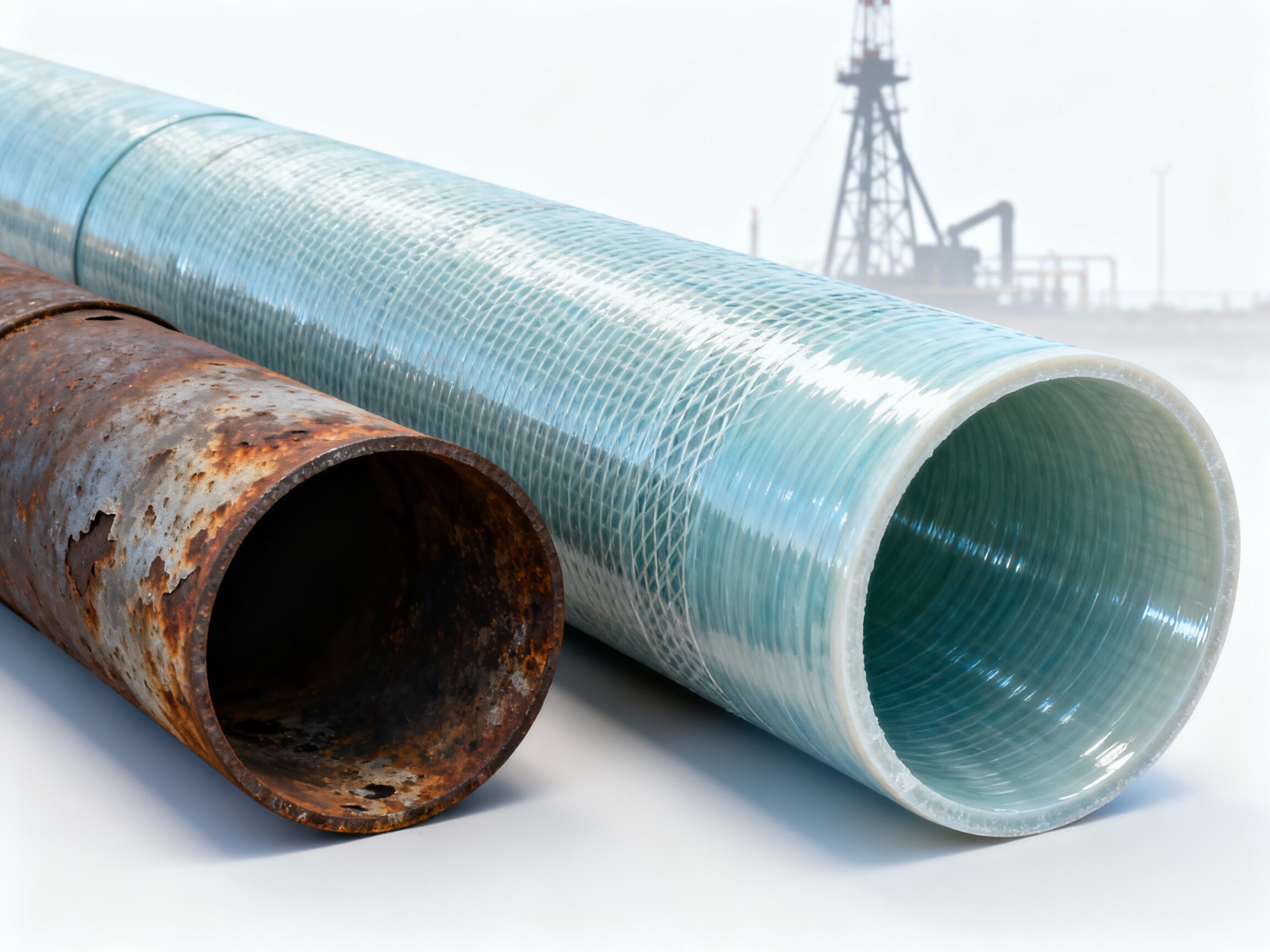
1. Excellent Corrosion Resistance (The Core Advantage)
• Handling Harsh Media: Fluids produced from natural gas fields often contain corrosive components such as H₂S (hydrogen sulfide), CO₂ (carbon dioxide), Cl⁻ (chloride ions), and formation water.
Traditional steel pipelines require corrosion inhibitors or expensive lining/alloys.
• A Fundamental Solution: GRE pipes are made of polymer resin and glass fibers, which do not undergo electrochemical corrosion and are almost completely immune to corrosion from these media.
This significantly extends pipeline service life (typically designed for over 20 years) and reduces the risks of leaks, production shutdowns, and safety incidents due to corrosion perforation, along with subsequent maintenance costs.
2. Lightweight and High-Strength, Easy Installation
• Light Weight: The density of GRE pipes is about one-quarter that of steel pipes, making them much easier to transport, hoist, and handle.
3. Superior Hydraulic Properties and Anti-Scaling
• Smooth Inner Wall: The absolute roughness of the GRE pipe's inner wall is much lower than that of steel pipes, resulting in lower frictional resistance.
Flow capacity is typically 10%-15% higher than in steel pipes of the same diameter, which can reduce pumping energy consumption.
• Scale and Wax Prevention: The smooth surface and hydrophobic properties make it difficult for wax, asphaltenes, scale, etc.,
to adhere, reducing the frequency of pigging operations and maintaining long-term, stable transportation efficiency.
4. Superior Whole-Life-Cycle Economics
• Initial Investment: While the material unit price of GRE pipes may be higher than that of ordinary carbon steel, considering their lower installation costs,
no need for cathodic protection, no need for internal anti-corrosion coating, and very low maintenance costs, the total installed cost (TIC) may be comparable to or even lower than that of steel pipes.
• Long-Term Operation: Over the long operational lifecycle, almost no maintenance costs are required for corrosion issues, avoiding production losses and replacement costs due to corrosion failure.
Their whole-life-cycle cost (LCC) is typically much lower than that of steel pipes.
Main Application Scenarios
In natural gas fields, GRE pipes are commonly used for:
• Gathering and transportation pipelines for corrosive media (especially in gas fields with high H₂S/CO₂ content).
• Produced water and water injection pipelines.
• Chemical injection pipelines (e.g., for corrosion inhibitors, methanol).
• Process piping within stations.
Please give us a message
产品介绍产品介绍产品介绍产品介绍产品介绍产品介绍产品介绍产品介绍产品介绍产品介绍产品介绍产品介绍产品介绍产品介绍产品介绍产品介绍产品介绍产品介绍产品介绍产品介绍产品介绍产品介绍产品介绍产品介绍产品介绍产品介绍产品介绍产品介绍产品介绍产品介绍
Please give us a message
产品介绍产品介绍产品介绍产品介绍产品介绍产品介绍产品介绍产品介绍产品介绍产品介绍产品介绍产品介绍产品介绍产品介绍产品介绍产品介绍产品介绍产品介绍产品介绍产品介绍产品介绍产品介绍产品介绍产品介绍产品介绍产品介绍产品介绍产品介绍产品介绍产品介绍
Please give us a message
产品介绍产品介绍产品介绍产品介绍产品介绍产品介绍产品介绍产品介绍产品介绍产品介绍产品介绍产品介绍产品介绍产品介绍产品介绍产品介绍产品介绍产品介绍产品介绍产品介绍产品介绍产品介绍产品介绍产品介绍产品介绍产品介绍产品介绍产品介绍产品介绍产品介绍
Please give us a message
产品介绍产品介绍产品介绍产品介绍产品介绍产品介绍产品介绍产品介绍产品介绍产品介绍产品介绍产品介绍产品介绍产品介绍产品介绍产品介绍产品介绍产品介绍产品介绍产品介绍产品介绍产品介绍产品介绍产品介绍产品介绍产品介绍产品介绍产品介绍产品介绍产品介绍